Leading Through the Noise: Assessment Tools for Meaningful Change
Education leaders are expected to make countless decisions each day that influence teaching, learning, staffing, resource allocation, and long-term improvement efforts. Yet in a landscape filled with competing priorities and continuous streams of information, one of the greatest challenges is determining which data truly matters—and how to use it in ways that lead to meaningful change.
For district and building leaders, that creates an important shift in focus. Success is no longer about simply collecting more information. It is about building systems that help leadership teams reflect, prioritize, collaborate, and make informed decisions that strengthen outcomes for students and staff.
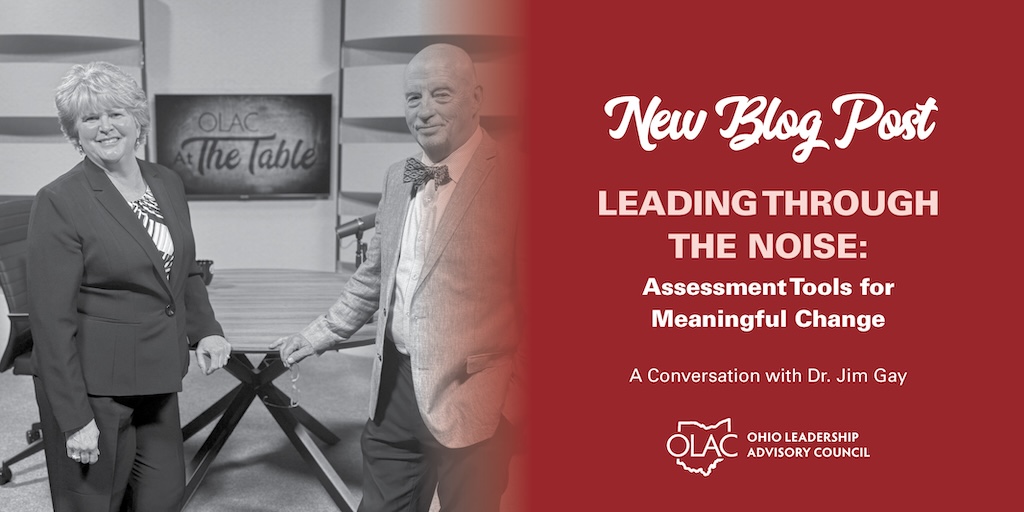
In a recent episode of At the Table, longtime superintendent and OLAC project coordinator Dr. Jim Gay discussed how OLAC assessment tools are helping leadership teams move from information overload to focused, actionable strategies.
At the center of the conversation was a simple but powerful idea: assessment tools should not just measure performance—they should help leaders strengthen systems, build capacity, and move the work forward.
From Informal Feedback to Meaningful Systems
“We didn’t really have many tools then,” Dr. Jim Gay explained while reflecting on the informal processes administrators once relied on to gather feedback and make decisions.
Even today, leaders are surrounded by continuous demands and data points—student achievement data, attendance trends, climate surveys, grant requirements, staff feedback, and accountability measures. Yet having access to more data does not automatically lead to better decisions. Without clear systems and meaningful structures, data can quickly become overwhelming instead of useful.
Three OLAC assessment tools are designed to help districts and schools strengthen leadership practices and support growth: the Ohio Sustainability Assessment Tool (OSAT), the Systemic Improvement Process Review (SIPR), and the Building Leadership Team (BLT) Assessment Tool.
Planning for Sustainability
What stands out most about these tools is that they are not designed to simply “score” schools or teams. Instead, they create opportunities for reflection, collaboration, and focused conversations around progress.
The Ohio Sustainability Assessment Tool addresses a challenge many districts know well—how to sustain successful initiatives after grant funding disappears. Too often, schools invest significant time and energy implementing promising programs, only to struggle once external funding ends.
“If you think that the grant is making a difference, you want to find a way to keep it going after the money’s gone,” Dr. Gay shared.
The OSAT helps districts examine areas such as partnerships, communication, and capacity-building so leaders can identify strengths and gaps before funding expires. Rather than reacting to challenges after the fact, districts can proactively plan for sustainability and long-term success.
Strengthening District Leadership Processes
The Systemic Improvement Process Review (SIPR) focuses on district leadership teams and school improvement processes. The tool helps teams evaluate how effectively their systems are functioning and identify targeted areas for growth.
Importantly, the results are not intended to be viewed as judgments. “You shouldn’t worry if your scores were in the first or second quadrant,” Dr. Gay explained. “What they are is just a starting score for you.”
That mindset matters. Growth requires leaders to honestly assess current practices while recognizing that stronger systems develop over time. The SIPR also connects districts directly to OLAC resources and professional learning opportunities aligned to the areas they want to strengthen.
Supporting Effective Building Leadership Teams
At the building level, the BLT Assessment helps principals and building leadership teams reflect on team effectiveness, collaboration, and decision-making practices. Building leadership teams play a critical role in shaping school culture and instructional improvement, yet principals do not always have formal opportunities to gather meaningful feedback about how those teams are functioning.
Dr. Gay noted that administering the assessments at the beginning of the year is “a really nice way to get conversation started, targeted conversation for each of those teams.”
That may be the greatest strength of these tools. They are not simply surveys or compliance measures. They are conversation starters that help leadership teams pause, reflect, and intentionally focus their efforts.
Moving the Work Forward
For Ohio’s education leaders, that kind of clarity matters. Sustainable improvement does not happen through isolated initiatives or endless streams of disconnected data. It happens when leaders create systems that support reflection, collaboration, and purposeful action.
Ultimately, effective assessment tools are not about compliance or collecting more information. They are about helping leadership teams focus on what matters most and creating stronger systems that improve outcomes for students, staff, and schools.
Listen and watch the full interview in Episode 27: Using Data in Public Education Leadership, on At the Table.