From Framework to Instructional Impact: Ohio’s New Integrated Multi-Tiered System of Supports (MTSS) Framework
Ohio’s education leaders are navigating a pivotal moment. With a statewide focus on early literacy, accelerated learning, and whole-child success, Ohio’s Integrated Multi-Tiered System of Supports (MTSS) framework offers a timely opportunity—not to start over, but to bring greater coherence and clarity to the work already underway in districts and schools.
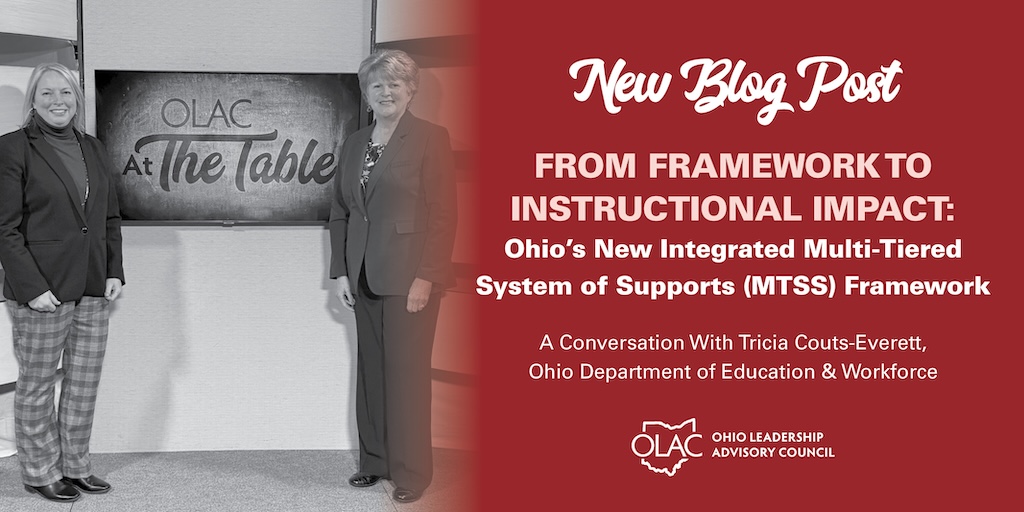
As Tricia Couts-Everett, Assistant Administrator, Unit of Integrated Systems of Academic Supports, at the Ohio Department of Education and Workforce shared on the At the Table podcast, the framework is best understood as a unifying structure, not a new initiative layered on top of existing ones.
“MTSS is not new,” she emphasized. “Districts and schools have been doing this work for a very long time.”
MTSS as the Glue, Not the Next Program
Ohio’s Integrated MTSS framework is intentionally designed to connect, rather than replace, local systems. Universal screening, data-informed decision making, progress monitoring, and problem-solving teams are familiar practices across the state. What the framework provides is a common language and structure to align those practices with Ohio’s priorities for literacy, math, and student success. Couts-Everett described the framework as “the glue for what we need to deliver for students,” explaining that it captures what research tells us works and keeps systems focused on effective instruction rather than fragmented initiatives.
A critical clarification for leaders is what Integrated MTSS is not. It is not a pathway to special education identification, nor is it solely about interventions. Instead, it is a framework for all students—those who are struggling, those meeting expectations, and those ready for enrichment.
“All students have needs,” Couts-Everett noted, “whether those needs are academic, behavioral, or both.”
Re-Centering Tier One Instruction
One of the most important messages embedded in Ohio’s MTSS framework is the renewed emphasis on Tier One core instruction. Too often, systems become overloaded with interventions without first examining the strength of everyday instruction.
Integrated MTSS intentionally flips that script. When student data signal concerns, the first question becomes: What is happening in core instruction? As Couts-Everett explained, the framework is designed to ensure that “we’re paying attention to what’s happening in Tier One instruction” before moving too quickly to additional layers of support.
This shift also highlights the importance of adult supports. High-quality instructional materials alone are not enough. Educators need time, training, and leadership that help them use those materials effectively. Integrated MTSS explicitly includes professional capacity, shared leadership, and communication as essential components—recognizing that strong instruction depends on strong systems around educators.
Leadership That Creates Conditions for Learning
For principals and district leaders, the framework reinforces a move toward instructional leadership. While operational responsibilities remain important, Integrated MTSS challenges leaders to consider how every decision—scheduling, staffing, professional learning—either supports or hinders effective instruction.
Couts-Everett described this as a shift toward “creating the conditions for high-quality instruction in every classroom,” particularly as Ohio implements new literacy requirements and high-quality instructional materials statewide.
That work includes understanding what strong instruction looks like, recognizing it in classrooms, and supporting teachers so that outdated practices do not quietly re-emerge. Ohio’s extensive network of state support teams, educational service centers, professional organizations, and higher-education partners plays a critical role in helping leaders grow into this work with confidence.
Keeping the Work Focused and Manageable
Perhaps the most practical guidance for districts and schools is also the simplest: don’t overcomplicate the work. Integrated MTSS can feel complex, but its purpose is clarity. Couts-Everett encouraged leaders to anchor their efforts around four guiding questions:
- Who needs help?
- Where is help needed?
- What kind of help is needed?
- Is what we’re doing working?
“These questions,” she noted, “keep the work focused on improving instruction for kids” and prevent teams from becoming overwhelmed by structures instead of outcomes.
A Framework for This Moment
Integrated MTSS is not a quick fix. It is a framework for thoughtful, sustained improvement—one that brings coherence to systems, strengthens instruction, and supports educators as they serve every learner.
For Ohio’s education leaders, the opportunity is clear: start with why, build shared understanding, and use the framework as a lever to align efforts around what matters most. When implemented with intention, Integrated MTSS has the power to turn complexity into clarity—and to ensure that every Ohio student receives the instruction and support they deserve.
Learn more in Episode 23: Exploring Ohio’s New Integrated Multi-Tiered System of Supports (MTSS) Framework, on At the Table.