Leading With Confidence: What Ohio’s Principals Need Now
Leadership in today’s schools requires far more than operational skill. It demands emotional intelligence, political awareness, instructional expertise, and the ability to build trust in increasingly complex environments. Principals are navigating legislative changes, evolving community expectations, student mental health needs, staffing shortages, and accountability pressures—all while keeping learning at the center.
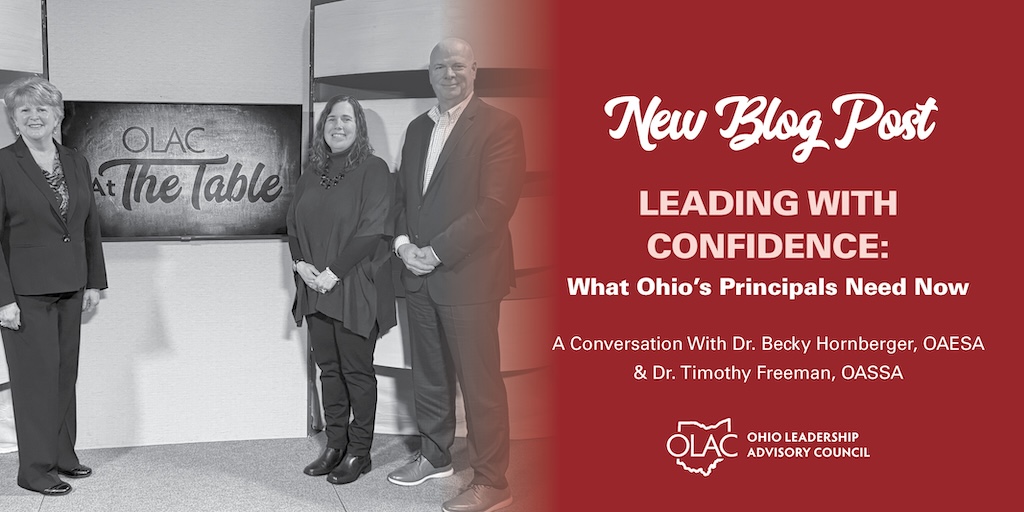
In a recent episode of At the Table, Dr. Becky Hornberger, Executive Director of the Ohio Association of Elementary School Administrators, and Dr. Timothy Freeman, Executive Director of the Ohio Association of Secondary School Administrators, reflected on what sustainable leadership looks like in this moment. Their message was reassuring and challenging: while the landscape feels more complex, the core of effective leadership remains steady—relationships, support systems, and an unwavering focus on students.
Leadership Is More Complex—But Relationships Are the Heart
There is no question that today’s principals face heightened expectations. Yet as Dr. Freeman noted, “Relationships are the heart of it.”
While policies and public discourse may shift, leadership still lives in daily interactions—with teachers, students, families, boards, and communities. Ohio’s districts are diverse, each with its own history and identity. Effective leaders know that navigating complexity is not about avoiding controversy—it is about building trust. Dr. Hornberger captured the resilience she sees across the state: “They have their heads down and focused on the work and the students and moving them forward.”
That steady focus sustains schools—even in challenging seasons.
Retention Starts With Connection
A central theme of the conversation was longevity in leadership. Through Ohio’s Beginning Administrators Academy and mentorship programs, new leaders are paired with experienced mentors outside their districts—trusted guides who offer perspective and support. The results are powerful: nearly every mentee remains in their role from year one to year two.
Dr. Freeman summed it up simply: “No one who did this job can say they did it by themselves.”
Leadership isolation is one of the greatest risks to sustainability. Community is the antidote. Dr. Hornberger added that these structures of support “promote that longevity we were talking about in the field.”
When leaders feel supported, they stay—and students benefit.
Job-Embedded Support Makes the Difference
Professional development matters. Conferences and workshops provide important learning. But what often makes the greatest difference is job-embedded support.
As Dr. Freeman described, principals frequently reach out in real time: “It may be, I’ve got something brewing and I want to talk it through… It may be, call me back right away—we’re in the middle of a crisis.”
Those conversations build capacity in the moment. They help leaders think strategically, respond calmly, and feel less alone. The message is clear: support must be practical, immediate, and relational.
Integrated MTSS: Not New—But More Connected
The discussion also explored Ohio’s emerging Integrated Multi-Tiered System of Supports (MTSS) framework. For some, the phrase “new framework” raises concerns about initiative fatigue. But both leaders emphasized that the work itself is not new.
“These are things good leaders already do,” Dr. Freeman said.
Strong leaders already analyze data, coordinate supports, and adjust instruction. The integrated model simply aligns academic, behavioral, and social-emotional systems into a cohesive whole. Dr. Hornberger distilled the heart of continuous improvement into three questions: “How are our kids doing? What are we going to do about it? and Did that work?”
That cycle reflects the essence of Ohio’s evolving framework—and effective leadership more broadly. It is about every student, every system, and ongoing reflection.
Shared Leadership and Accountability
The conversation also highlighted a critical balance: shared leadership and individual accountability. Dr. Freeman explained that leadership requires “an awareness and an embrace of shared leadership, but an acceptance of individual accountability.”
Collaborative teams and shared decision-making strengthen schools. Yet principals remain accountable for safety, compliance, and outcomes. Shared leadership does not dilute responsibility. It strengthens collective capacity while maintaining clear accountability.
Dr. Hornberger emphasized that culture makes this possible. When educators trust that decisions are made with students first, “it becomes a lot more palatable, and they trust that decision.”
Trust fuels shared leadership.
The Work Ahead
Across Ohio, principals and district leaders are strengthening literacy systems, navigating legislative updates, leading instructional improvement, and building cultures where educators feel safe to innovate. Most importantly, they are keeping students at the center. As Dr. Hornberger reflected, “We are so lucky to be able to have the opportunity to be that person”—the adult who makes a difference in a child’s life.
That sense of purpose anchors leadership—even in complex, messy seasons. The mentorship programs, consultative supports, professional learning opportunities, and integrated frameworks discussed are not isolated efforts. They are part of a broader ecosystem designed to sustain leaders and strengthen outcomes for students.
The message is simple:
- Stay connected.
- Lean into relationships.
- Focus on every student.
- And remember—you were never meant to do this alone.
Listen and watch the full interview in Episode 24: The Role of Mentorship in Developing Leaders, on At the Table.