Ohio’s Integrated Multi-Tiered System of Supports (MTSS) Framework: Improving Academic and Non-Academic Instruction and Supports for All Learners
May 2026

The use of tiered prevention frameworks (i.e., frameworks that include universal, targeted, and intensive prevention strategies) is not a new phenomenon. Rather, they were used extensively in the field of public health as early as the 1960s and appeared much later in education with the 1997 reauthorization of the Individuals with Disabilities Education Act (IDEA).
The introduction of Positive Behavioral Interventions and Supports (PBIS) as part of the 1997 reauthorization provided an early model for coordinating interventions to address both academic and behavioral concerns at three levels: (1) universal (students without serious academic or behavioral issues, (2) secondary (students at risk for academic or behavioral issues), and (3) tertiary (students with chronic or intense academic or behavioral issues) (Sugai et al., 1998).
IDEA reauthorization and regulations in 2004 and 2006, respectively, retained PBIS and introduced Response to Intervention (RtI), while aligning components of IDEA and the No Child Left Behind (NCLB) act. Later, NCLB reauthorization (the Every Student Succeeds Act or ESSA) emphasized integrated supports, PBIS, and multi-tiered system of supports (MTSS) (I-MTSS Research Network, 2023, p. 1-2).
Today, all states use a form of MTSS to address academic and/or behavioral concerns, but not all states use an integrated model (I-MTSS Research Network, 2024, p. 1). “Within an I-MTSS framework, states, districts, and schools fully integrate data systems, teaming, professional development, and practices to cohesively support students’ academic and behavioral needs.” (I-MTSS Research Network, 2023, p. 1)
Ohio’s Integrated MTSS Framework: Proactive and Responsive
The Ohio Department of Education and Workforce (DEW) developed Ohio’s Integrated Multi-Tiered System of Supports (Ohio's Integrated MTSS), initially releasing guidance in Fall 2025. DEW describes Ohio’s Integrated MTSS framework as “a framework for student success designed to assist districts and schools in developing a local multi-tiered system of supports (DEW, 2025).
In Ohio's model, key components are designed to facilitate the delivery of effective, data-informed academic and non-academic instruction and supports to all students. Rather than using Integrated MTSS as a prevention-only approach for at-risk or struggling students, the framework serves ALL students, including those at risk of not meeting grade-level expectations as well as those ready for instruction beyond grade-level expectations.
The “ALL” in Ohio’s framework also extends to adults. DEW states: “Ohio's Integrated MTSS is the collective responsibility of all levels of the educational system. Through collaborative leadership and teaming, focused professional learning, and consistent communication and collaboration, each level plays a role in creating the conditions for effective academic and non-academic instruction and supports for all Ohio students.“ (DEW, 2025).

“Ohio’s Integrated MTSS framework isn’t just an improvement model,” explained Tricia Couts-Everett, Assistant Administrator of DEW’s Office of Instructional Coherence and Impact. “It’s a proactive and responsive approach to setting up a student success system.” “It’s also for those students ready for instruction beyond grade-level expectations; all students are included in Ohio’s model,” emphasized Kerry Martinez, Administrator of the Office of Instructional Coherence and Impact at DEW.
Couts-Everett elaborated: “Response to Intervention (RtI) was an earlier iteration of a tiered model for providing supports to students. It could be that some districts and schools in the state are still implementing from an RtI perspective, which would be focused on academic needs, perhaps, and just focused on those students who are at risk. We would say that an integrated multi-tiered system of supports considers academic and non-academic supports in conjunction with one another. For example, rather than having an academic team and a non-academic team that siloes the work, an integrated approach looks at academic and non-academic data and the interplay between them, rather than looking at them separately.”

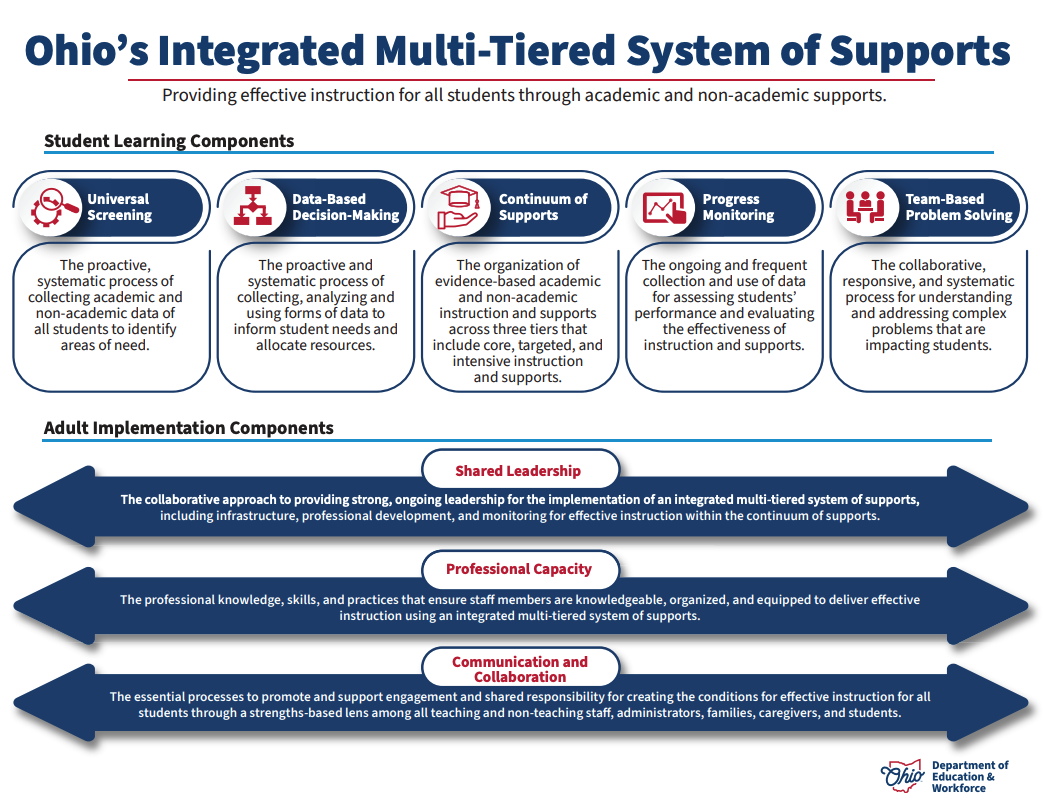
Ohio’s model broadens the conceptualization of non-academic supports beyond a focus on only behavior to include, for example, supports for addressing wellness, attendance, and related factors. In addition to supporting the integration of academic and non-academic supports, Ohio’s model articulates the adult implementation components – using shared leadership, building professional capacity, and ensuring effective communication and collaboration across the system – that act as conditions for supporting student success.
Critical components necessary for supporting student learning include universal screening, data-based decision-making, providing a continuum of supports, progress monitoring, and team-based problem-solving. DEW defines these components as actions that occur to deliver effective instruction to students; components are not linear and not siloed (DEW, 2025).
“While traditional MTSS frameworks might focus on just one or two domains, Ohio’s Integrated MTSS framework emphasizes instructional coherence within each domain and also across different domains by strategically integrating key effective practices in both academic and non-academic contexts,” explained Couts-Everett.

Refining existing processes through Ohio’s Integrated MTSS framework. “We recognize that the use of MTSS is in place in many districts in Ohio; it’s not unfamiliar to the education system. Ohio’s Integrated MTSS framework provides an opportunity for refinement, for reviewing and aligning priorities from the system level to the instructional level,” explained Martinez.
Rather than “putting a child through MTSS” or identifying children by tiers (e.g., he’s a Tier 2 kid), Ohio’s Integrated MTSS framework is about the core instruction and supports provided to all students, and the additional targeted and/or intensive supports provided to students who need them. The framework is not a pathway to identifying students for special education services, nor is it only for districts/schools identified as being in need of improvement.
“It’s about what supports are needed to improve students' access to effective instruction whether they're identified for special education, whether they're identified as gifted, or whether they’ve just missed the cut point to be officially identified for gifted instruction. Ohio’s Integrated MTSS framework is for all learners,” said Couts-Everett.

“It requires the collective responsibility of all adults across all parts of the education system and that means we have to start by changing mindset,” added Martinez. Districts and school leaders are key in translating the framework into daily practice by aligning systems, empowering teams, and fostering a culture of continuous improvement,” she added.
In addition to using locally developed MTSS models, the majority of Ohio districts and schools have used the Ohio Improvement Process (OIP), first developed in 2007, as their primary improvement framework. Prior to the development of OIP, the Ohio Integrated Systems Model (OISM) was used by a number of schools partnering with the Ohio Department of Education as part of Ohio’s State Improvement Grant/State Personnel Development Grant (SPDG). OISM focused on the coordinated use of academic supports and PBIS (Graden et al., 2007).
Couts-Everett describes the evolution from OIP to Ohio’s Integrated MTSS framework as one focused first and foremost on the delivery of effective instruction:
We continue to focus on improvement processes, and we'll utilize the integrated MTSS framework as the lever. The important thing is ensuring that improvement practices are focused on instruction, at the building and classroom level, to ensure high impact on student outcomes. Districts and schools will find consistency between OIP and Ohio’s Integrated MTSS framework, particularly in areas such as shared leadership, the use of strong teaming structures, two-way communication across those teaming structures, data-based decision-making, and team-based problem solving. Where districts and schools may need to enhance or refine their work really depends on how they've been approaching continuous improvement and the use of existing MTSS processes. And we want to be careful not to make assumptions about this. Having said that, there are specific areas where we've been intentional in our messaging (i.e., that there's a clear focus on the delivery of effective instruction, and a clear focus on driving and supporting this delivery of effective instruction). The emphasis here is that improvement practices must happen at the building and classroom level and must be focused on delivering effective instruction that's grounded in data-based decision-making.
Building the Throughline to Effective Instruction for All Students

Resources to assist Ohio districts and schools in understanding Ohio’s Integrated MTSS framework are available on DEW’s website page Ohio’s Integrated Multi-Tiered System of Supports. Descriptions of each component (e.g., progress monitoring, universal screening) of the framework are provided along with PowerPoint presentations and webinar recordings.
Work is ongoing to align how Ohio’s Integrated MTSS framework emphasizes instructional coherence within each domain and across different domains through the integration of academic and non-academic supports, and to support the use of the framework by districts in developing their One Plans.
Additionally, DEW is working to identify essential leadership practices at the district/central office and school levels that are needed for the effective use of the framework. More information will be provided in the coming months.
References
Graden, J. L., Stollar, S. A., & Poth, R. L. (2007). The Ohio Integrated Systems Model: Overview and lessons learned. In Jimerson, S. R., Burns, M. K., & VanDerHeyden, A. M. (Eds) Handbook of response to intervention. Springer, Boston, MA. https://doi.org/10.1007/978-0-387-49053-3_22.
I-MTSS Research Network. (2023). Brief history of I-MTSS: Summary of major milestones toward an I-MTSS framework. Integrated Multi-Tiered Systems of Support Research Network, University of Connecticut, http://www.mtss.org.
I-MTSS Research Network. (2024). What is the current state of I-MTSS implementation? Integrated Multi-Tiered Systems of Support Research Network, University of Connecticut. http://www.mtss.org.
Ohio Department of Education and Workforce (October 30, 2025). Understanding student learning components within Ohio's Integrated Multi-Tiered System of Supports - PDF Presentation | Recording
Sugai, G., Kame’enui, E. J., Horner, R. H., & Simmons, D. C. (1998, April). Effective instructional and behavioral support systems: A school-wide approach to discipline and early literacy. Green Conference on Achieving Universal Literacy, University of Texas, Dallas, TX.
For More Information
For more information about Ohio’s Integrated Multi-Tiered System of Supports (MTSS) framework, contact:
- Kerry Martinez, Administrator, Office of Instructional Coherence and Impact, Ohio Department of Education and Workforce (DEW), at kerry.martinez@education.ohio.gov; or
- Tricia Couts-Everett, Assistant Administrator, Office of Instructional Coherence and Impact, DEW, at Tricia.Couts-Everett@education.ohio.gov
For more information about resources to support districts, contact:
- OLAC Director Mike Trego at trego@basa-ohio.org; Elizabeth Lolli, PhD, Co-director, at lolli@basa-ohio.org;or Jim Gay, PhD, Consultant, at jimgay@basa-ohio.org.